
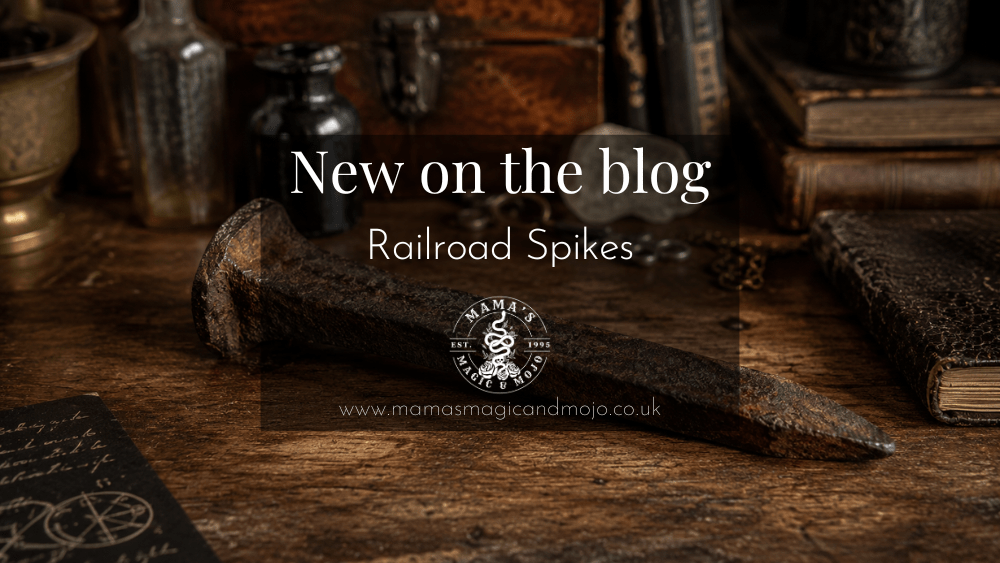
I’ve got railroad spikes sat on my desk, and despite the fact I haven’t decided where any of them are going yet, I keep picking them up every time I walk past. One’s older than the others, one’s rustier, and one’s still got the maker’s mark stamped into the head. I don’t even know what I’m looking for when I turn them over in my hand. I just like them. Every scrape, every dent and every patch of rust makes me wonder where that spike’s spent the last however many decades before it somehow found its way onto my workbench in rural Lancashire. It’s a bloody long way from the railroads it was made for, and yet here we are.
I’ve also come to the conclusion that railroad spikes are a little bit addictive. You buy one because you’ve got a working in mind, then you spot another one somewhere and immediately start justifying why you need it. “Well… this one’s older.” Or, “That one’s got a different maker’s mark.” Before you know it you’ve somehow accumulated a small pile of the bloody things and you’re explaining to people that, no, they aren’t all exactly the same. They look at you like you’ve lost the plot. You look at them wondering why they can’t appreciate a particularly nice bit of old iron. Everybody goes home happy.
I suppose I should explain why I’m sat here rambling about railroad spikes in the first place. Hoodoo and New Orleans Voodoo aren’t interests I stumbled across one afternoon because an algorithm decided I’d enjoy them. They’re part of my family. I’m Louisiana Creole through my mum’s side (read my about section here if you want to know how), and these traditions have always been there. They weren’t presented to me as mysterious or exotic. They were practical. They were just part of life. Looking back, I think that’s one of the reasons I sometimes find myself quietly arguing with the internet. Hoodoo has an annoying habit of being far simpler than people want it to be. Somewhere along the line we’ve convinced ourselves every magical tool has to come with a dramatic origin story, be wrapped in black velvet and cost the same as a small mortgage. Hoodoo has never really worked like that. It looks at ordinary things and asks a very simple question. What’s this already good at?
That’s one of the reasons I love railroad spikes so much. They were made to hold a railway together. That’s it.
No hidden symbolism. No mysterious secrets. Just a great lump of forged iron designed to stop steel rails wandering off while hundreds of tons of train barrelled over the top of them day after day, year after year. When you stop and think about it, that’s exactly the sort of reputation you’d want to bring into protective work. You don’t have to invent some elaborate correspondence because the spike’s already spent years demonstrating exactly what it does. It stays put when everything around it is trying to shake it loose. Hoodoo didn’t have to make railroad spikes magical. It simply recognised what they already knew how to do, and I think that’s clever as fuck.
That’s something I don’t think gets talked about enough. Hoodoo is incredibly practical. It always has been. A key opens things. A lock keeps things shut. A broom sweeps away what you don’t want hanging around. A mirror throws something straight back where it came from. The object tells you what it does if you’re willing to pay attention. I sometimes wonder whether that’s why people overcomplicate hoodoo now. We’ve become so used to looking for hidden meanings that we forget the obvious ones are often staring us in the face.
The railroads changed huge parts of America, and with them came millions of these spikes. Tracks needed repairing, old spikes were pulled out, new ones were hammered in, and suddenly there was an endless supply of heavy forged iron lying around. Rootworkers looked at them and saw possibility instead of scrap, which doesn’t surprise me in the slightest. Hoodoo has always been resourceful. It’s never been about waiting until you’ve got the fanciest tools money can buy. Quite the opposite. It has a wonderful knack for looking at the ordinary and seeing something everybody else walked straight past. That’s probably why I can’t help laughing when I see somebody selling “spiritually activated railroad spikes” online for three times the price of a normal one. Bless them. It’s a railroad spike, not Excalibur. If you have to convince me it’s magical with a marketing description, you’ve rather missed the point.
Now, before somebody starts furiously typing me an email, no, I’m not saying you have to find an old spike that’s spent the last century buried beside a railway line. Iron’s iron. If a new railroad spike is what you’ve got, then use a new railroad spike. Hoodoo has never been about refusing to work until you’ve found the perfect tool. I just happen to like old ones. I like the history they carry. I like wondering how many trains have passed over them. I like the fact they’ve already spent years doing exactly what I’m asking them to keep doing. Holding firm. Staying exactly where they’re put. Refusing to give way under pressure. That doesn’t magically make an old spike more powerful than a new one in my eyes. I just like old things, ask my husband (oh the cheek!) 😉
The best known use for railroad spikes is probably protecting property. Four spikes, one driven into each corner of your land, marking the boundary and holding it fast. Like most things in hoodoo, there isn’t one single way of doing it. Some workers include silver coins. Some use graveyard dirt gathered correctly. Some pray Psalms while setting the spikes. Others keep things beautifully simple. That’s one of the things I appreciate about hoodoo and in fact all types of folk magic. It isn’t obsessed with everybody doing everything exactly the same way. Different families have different traditions. Different communities have their own ways of working. The heart of it stays the same. The spike is there to hold the line, and I love the continuity in that. It held a railway together for years, and now it’s holding the spiritual boundary around your home.
You don’t need four spikes either. A single spike beside your front door or gate makes perfect sense because thresholds are important They always have. They’re where one space becomes another. Where outside becomes inside. Where strangers become guests, or don’t if you’ve got anything to say about it. One working I particularly like uses two railroad spikes bound together into a cross and hung above the front door. It always makes me smile when I see that written about because it was already familiar to me through family long before I ever found it in print. That’s one of the lovely things about reading books on traditions you’ve grown up with. Every now and then you’ll stumble across something and think, “Well, there you are then.” Not because you needed the book to prove your family knew what they were doing, but because it’s nice seeing another branch of the same tradition nodding back at you across the page.
The same goes for waking up a railroad spike before it goes to work. That’s my phrase for it, and I’m sticking with it. Some people might say they’re blessing it. Others might say they’re feeding it or dedicating it. To me, I’m waking it up. I’ll cleanse mine first, usually with Florida Water or rum. Rum has always had its place in New Orleans Voodoo, so reaching for a bottle has never felt remotely unusual. Then I’ll soak the spike, place it on a heat-safe surface, carefully set it alight, let it burn itself out naturally and, once it’s cool, dress it with Protection Oil before putting it where it belongs. That was the way I was taught, and years later it made me smile when I found essentially the same preparation described elsewhere. I always enjoy those moments. Not because I need somebody else to validate what my family taught me, but because it’s a reminder that these traditions didn’t exist in isolation. Families shared knowledge. Communities shared knowledge. That’s how living traditions survive.
Iron itself has a much longer story to tell than railroad spikes do. Across different cultures you’ll find it turning up again and again in protective work, although not always for the same reasons and I do think it’s important not to flatten everything into one vague tale about “ancient beliefs”. European folklore has its own understanding of iron. In West African traditions, iron carries sacred associations through Ogun. Blacksmiths occupied respected positions in many societies. Old cemeteries were often enclosed by iron railings. None of those traditions are identical, but they all tell us something about the reputation iron had already earned long before somebody looked at a discarded railroad spike and thought, “That’ll do nicely.”
Protection is only part of the story too. Railroad spikes turn up in road opening work, which makes perfect sense when you stop and think about what a railway does. It creates a route. It carries people forward. It connects one place with another. You’ll also find spikes used in workings for strength, stability and perseverance, and again I don’t think that’s because somebody sat down trying to invent a clever correspondence. It’s because the object has already spent its entire life demonstrating those qualities. Hoodoo has always been brilliantly straightforward like that.
While I was digging into the history of railroad spikes again for this blog post, I came across an older territorial working involving driving a spike into the earth with a silver coin placed on top before the work was completed. There’s considerably more to it than that, but I’m quite deliberately not turning every traditional working into a step-by-step guide on the internet. I don’t think that’s respectful to the traditions, and I don’t think everything needs to become content.
One thing I will always do, though, is check claims before I repeat them. Maybe it’s because this is my family’s tradition, but I get a bit twitchy when I see people confidently stating things that don’t seem to have much evidence behind them. I found plenty of websites insisting railroad spikes were traditionally used for jinxing footprints or binding court cases, so I went looking. Properly looking. Could somebody, somewhere, have adapted a railroad spike for those jobs? Quite possibly. Hoodoo has always adapted to circumstances. But that’s very different from saying it’s a recognised traditional use, and I couldn’t find enough to satisfy me. I’d much rather tell you less and know it’s true than pad a blog post out with stories that sound impressive but fall apart the minute somebody asks where they came from. So if you want to use them for court cases and jinxing be my guest, no one is stopping you. I had just not done this myself growing up, that’s all I’m saying.
Anyway, I’ve still got these railroad spikes sat on the desk. One already knows where it’s going. Another’s got a fairly good idea. The third is still sat there waiting while I continue picking it up every time I walk past. I suspect I’ll work it out eventually. Either that or I’ll buy another one before I’ve decided, which, if I’m being honest, seems the more likely outcome.
Want one of your own? Have a peek here.